







Россия
Астрахань, Россия
Россия
В статье рассматриваются актуальные вопросы повышения нефтеотдачи пластов с использованием диоксида углерода (CO2) и наночастиц. Отмечается, что средний коэффициент извлечения нефти в мире составляет 10–18 %, а увеличение на 10–20 % позволило бы значительно увеличить запасы сырья и повысить конкурентоспособность российской нефтяной отрасли. Показаны пределы применимости различных методов повышения нефтеотдачи пластов в зависимости от глубины залегания пласта и вязкости нефти. Среди газовых агентов CO2 выделяется своей высокой растворимостью в нефти и воде, благоприятной динамической вязкостью (в 2–3 раза выше, чем у метана или азота) и степенью сжатия, что обеспечивает повышенную рентабельность при извлечении остаточного сырья. Однако основной проблемой при его закачке является преждевременный прорыв газа в добывающие скважины. Эффективным решением является добавление наночастиц (SiO2, Tio2, ZnO, Al2O3), которые вместе с поверхностно-активными веществами образуют стабильную высоковязкую пенную структуру, улучшающую промывку резервуара и снижающую подвижность CO2. Такие наносистемы избирательно снижают проницаемость каналов высокоскоростного потока, где CO2 перемещается наиболее интенсивно. Проанализированы ключевые факторы, влияющие на стабильность пены CO2 с наночастицами: размер частиц (наиболее эффективными являются частицы размером 20 нм, например гидрофильный SiO2 A300), смачиваемость поверхности (оптимальный угол смачивания 26–56°), концентрация гидрофильных наночастиц и температура (повышение температуры снижает стабильность, но Al2O3 проявляет более высокую стойкость и стабилизирующий эффект, чем у SiO2). Преимущества использования различных ок-сидов рассматриваются отдельно. Сделан вывод, что, несмотря на многообещающие лабораторные результаты, необходимы дальнейшие исследования механизмов взаимодействия наночастиц с ионами солей и полимерами, а также испытания для крупномасштабного хранения CO2 и повышения нефтеотдачи пластов.
диоксид углерода, наночастицы, повышение нефтеотдачи пластов, пена CO2, стабильность пены, смачиваемость, межфазное натяжение
Introduction
Increasing the efficiency of crude oil production is considered a top priority for both the Russian and global industrial sectors. Currently, the average oil recovery varies between 10-18% depending on the region and the country. An increase in this indicator in the Russian Federation by 10-20% will significantly increase oil reserves, increase the competitiveness of domestic enterprises on the international market and increase financial resources to the state budget [1, 2]. Figur schematically shows the limits of applicability of the applied methods in order to increase oil recovery, depending on the depth of the reservoir and the viscosity of the oil fluid.
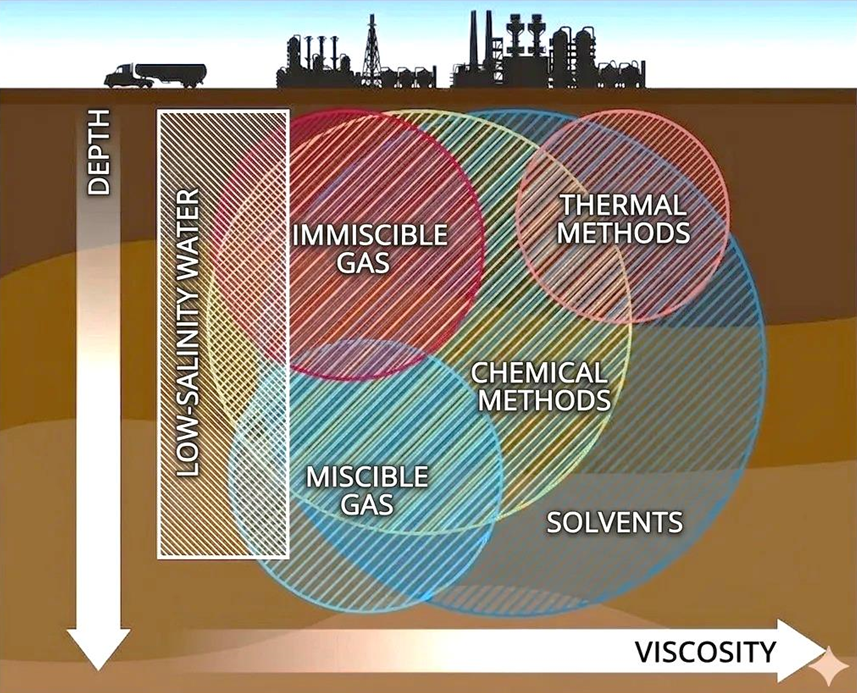
Limits of increasing oil recovery methods applicability (from open sources)
A number of researchers have studied the mechanism of interaction of CO2, methane and nitrogen with petroleum raw materials in reservoirs. The data obtained lead to the conclusion that CO2 behaves more positively in relation to other gas media in the conditions of extraction of residual petroleum raw materials, since it easily dissolves in it and the aquatic environment at relatively low pressure and temperature, which determines the increased profitability of extraction of residual petroleum raw materials by CO2 [3, 4].
The dynamic viscosity of CO2 is twice or three times higher than that of other gas media under consideration, which is important, since the ratio of viscosity of gas and reservoir liquid media determines the duration of displacement of crude oil by the injected agent until it passes into the wells. At the same time, the degree of CO2 compression also differs significantly from it for methane and nitrogen, especially at elevated pressure. The capacity of compressor stations used to compress gas media during transportation and injection into the reservoir structure is also determined by the degree of compression [3, 5, 6].
The main obstacle to the implementation of CO2 injection projects is its premature passage into the well. In order to minimize the mobility of CO2 and increase the efficiency of its contact with the displacing fluids of reservoir structures, it is recommended to introduce various chemical compounds into them. For example, surfactants with nanoparticles (NPS) form a stable foam structure with increased viscosity, which leads to an increase in the efficiency of washing oil raw materials by CO2. The use of a foam structure as an injected medium determines a more efficient displacement of petroleum raw materials in relation to flooding or injection of compressed CO2 [6, 7].
The high chemical stability of LPS even in harsh conditions of the existence of a reservoir structure and their significant selectivity of adsorption at the interface of liquid media is attractive for their use for the formation of emulsions and foam structures [3, 5], since the surface treatment of LPS can focus on specific molecules, which causes the formation of a foam system CO2/aqueous medium without the formation of emulsions of the oil raw materials/water environment. In this variant, nanofluidic media and nanofluidic media affect the interfacial tension (MFN), rheological parameters and the degree of surface wettability. Polymer solutions and surfactants can be modified by adding nanoparticles to change the wettability of the rock, reduce interfacial tension, and improve rheological properties. Thanks to these advantages, nanotechnology can revolutionize the ways of extracting petroleum raw materials [8].
In order to co-inject CO2 with NPS to form nanostructures stabilized by NPS, a threshold shear intensity is required [6, 9], the high value of which in permeable reservoir structures is present in the main flow channels, which are located mainly in the zones with the highest penetrating power. These parameters increase the likelihood of the formation of “self-conducting” fluids that selectively reduce the mobility of CO2, forming a foam structure only where CO2 is displaced at high speed, in particular, in fractured and/or areas of gravity with a relatively low concentration of residual petroleum. This foam structure has the ability to mix with it, which leads to an increase in the degree of extraction of petroleum raw materials associated with CO2 foam flows [8, 10].
Currently, LPS are widely used in many fields of research and in industry. They make it possible to improve the characteristics of underground fluids injected into boreholes and the behavior of reservoir fluids. Nanoparticles are able to penetrate porous underground environments, which allows them to travel long distances through pore spaces and channels in reservoir formations. [6, 9–11]. Their effects are facilitated by the interaction between injected and pore fluids, which allows them to influence specific zones and fluid flow characteristics deep in oil reservoirs.
In particular, the addition of NPS to a foam with a surfactant tends to improve the stability of the foam, which is due to their beneficial properties, such as the absence of exposure to certain characteristic conditions commonly found in oil formations, such as high temperatures and the presence of a number of hydrocarbons and/or salts. In addition, due to their small size, the LF flow through the porous medium is not significantly hindered by the reservoir matrix itself, which leads to minimal changes in reservoir permeability, while foam absorption by reservoir rocks is negligible. In addition, the materials from which the necessary NPS are obtained, for example, coal ash, can be obtained at minimal cost. Due to their grafting properties, the wettability of the nanoparticles can be changed relatively easily to obtain a foam resistant to groundwater. The degree and duration of foam stability depend on several factors, including the interaction between the size of the LF and the foam, the wettability of the LF surface, the concentration of LF and their surface charge, as well as the charge of the surfactant and the salinity of water, the saturation and temperature of reservoir oil, the properties of crude oil, the flow rate of liquid in the reservoir, as well as the absorption of foam by the formation matrix [6, 9–11].
Let us consider separately the influence of the main factors of the use of LPS for the purpose of efficiency of the heavy oil production process.
The effect of particle size on the characteristics of CO2 foam
Nanoparticles with a size of 20 nm most effectively increase the stability of the foam. Nanoparticles with a size of 20 nm create more uniform layers inside the foam, preventing it from enlarging and sticking together. The addition of various NPS (SiO2 A300 (hydrophilic), SiO2 R816 (hydrophobic), ZnO, TiO2) to the surfactant showed that foam stability is best improved when using SiO2 A300 due to the higher ratio of surface area to particle size. In addition, surfactants can attach to the surface of nanoparticles and increase their catalytic activity due to a larger surface area and a smaller particle size. As a result of the attachment of surfactant molecules to the surface of the NPS, steric lamella layers are formed that prevent compression and expansion. This feature helps the foam to maintain stability during storage and transportation [12].
The effect of the wettability of the woofer surface on the characteristics of CO2 foam
The surface wettability of NPS is determined by the ratio of the forces of adhesion of the molecules of the liquid medium and the molecules (or atoms) of the wetted substance/(adhesion) and the forces of mutual adhesion of the molecules of the liquid medium (cohesion). The effect of the wettability of the LF surface on the stability of the foam was evaluated using Aerosil SiO2 as a hydrophobic component. It was found that the stability of the foam increases, and the wetting edge angle increases by 26-56°. The addition of colloidal SiO2 AEROSIL816 and SiO2 AEROSIL300 to the surfactant sodium dodecyl sulfate showed that the wettability of the rock surface largely determines and controls the location, distribution, and movement of fluids in a particular formation [10, 13].
Effect of the concentration of hydrophilic NPS on the characteristics of CO2 foam
It is now well known that the presence of hydrophilic NPS increases the stability of the foam. The rheological properties of supercritical CO2 foam at various temperatures, foam qualities, and pressures are informative in this regard. The use of synergy between nanoparticles and polyoxyethylene lauryl ether (C12E23) to stabilize CO2 foam was evaluated using static stability tests, visualization of pores using microscopic models, and sandbag filling tests. NP-C12E23 is highly resistant to salinity and temperature. It perfectly controls the profile and blocks water, and during the experiments, the oil recovery coefficient increased by 20.1% after water injection. Most studies today are limited to one type of NPS or surfactant. Static and dynamic tests to assess the relative effectiveness of various types of NPS and surfactants in stabilizing CO2 foam under subcritical and supercritical conditions have not yet been carried out sufficiently [10, 14].
Influence of temperature on the characteristics of CO2 foam with LF
The effect of temperature on the stability of low-gain CO2 foam is complex and is associated with a number of competing processes. With increasing temperature, solvent evaporation
The number of foaming agents tends to increase, and as a result, depending on the concentration of the foaming agent and its structure, the stability of the foam may increase or decrease. The presence of SiO2 and/or Al2O3 NPS in the foam slows down the rate of liquid release, thereby slowing down the process of bubble fusion. This ultimately increases the half-life and stability of the foam at any temperature. It was found that Al2O3 NPS, regardless of the pH value of the system, have a more stabilizing effect than SiO2 NPS at all tested temperatures. As a result, it is noted that the stability of the foam in the presence of NPS decreases with increasing temperature [10, 15].
Conclusion
The analysis shows that the use of carbon dioxide (CO2) to enhance oil recovery is a promising area, especially in the extraction of hard-to-recover and residual petroleum raw materials. CO2 compares favorably with other gas agents (methane, nitrogen) with its high solubility, favorable dynamic viscosity and compression ratio, which ensures more cost-effective oil displacement. However, the key obstacle – the premature breakthrough of CO2 to the producing wells – significantly reduces the efficiency of the process. The most effective technical solution to this problem is the joint injection of CO2 with nanoparticles and surfactants, resulting in the formation of a stable highly viscous foam. This foam structure selectively reduces the mobility of CO2 in highly permeable channels and fractured zones, increasing reservoir coverage and oil recovery rate.
1. Жумаев К. К., Туракулова М. К., Бурхонов И. У. Методы разработки высоковязкой нефти // Теория и практика современ. науки. 2019. № 3 (45). С. 126–129.
2. Петрова Л. В. и др. Современные проблемы и перспективы роста добычи тяжелых нефтей в России // The Scientific Heritage. 2017. № 13-2 (13). С. 28–30.
3. Калинин В. Ф. Геолого-физические критерии вы-бора оптимальной технологии повышения продуктивности скважин методом обработки призабойной зоны поверхностно-активными веществами // Недра Поволжья и Прикаспия. 2024. № 115. С. 4–36.
4. Гусейнов Г. Г. Исследование критических технологий для интенсификации добычи трудноизвлекаемых запасов нефти // Научные исследования: итоги и перспективы. 2021. Т. 2. № 1. С. 14–27.
5. Калинин С. А., Морозюк О. А. Разработка месторождений высоковязкой нефти в карбонатных коллекторах с использованием диоксида углерода. Анализ мирового опыта // Вестн. ПНИПУ. Геология. Нефтегаз. и гор. дело. 2019. Т. 19. № 4. С. 373–387.
6. Калинин С. А., Морозюк О. А. Лабораторные исследования карбонатных коллекторов месторождений высоковязкой нефти с использованием диоксида углерода // Недропользование. 2020. Т. 20, № 4. С. 369–385.
7. Стромов К. А., Гарипов А. Ф. Особенности, возможные осложнения и недостатки использования диоксида углерода для повышения нефтеотдачи // Инновац. науч. исслед. 2021. № 5-2. С. 56–61.
8. Карамышев В. Г., Эпштейн А. Р., Пчелинцев Ю. В. Применение методов нанотехнологий для интенсификации добычи нефти // Нефтепромысл. дело. 2008. № 1. С. 25–27.
9. Гараев Т. Г. Перспективы применения нанотехнологий при добыче нефти // Проблемы геологии и освоения недр: тр. XVIII Международ. симп. им. акад. М. А. Усова студентов и молод. ученых, Томск, 7–11 апреля 2014 г. Томск: Изд-во ТПУ, 2014. Т. 2. С. 70–72.
10. Al-Shargabi M. et al. Carbon dioxide applications for enhanced oil recovery assisted by nanoparticles: Recent developments // ACS omega. 2022. Vol. 7. N. 12. Р. 9984–9994.
11. Воробьев А. Е. Основные принципы эффективного применения промышленных нанотехнологий при добыче аквальных газогидратов // Экспозиция Нефть Газ. 2015. № 2 (41). С. 28–31.
12. Ahmadi Y., Mansouri M., Jafarbeigi E. Improving simultaneous water alternative associate gas tests in the presence of newly synthesized γ-Al2O3/ZnO/urea nano-composites: an experimental core flooding tests // ACS omega. 2022. Vol. 8. N. 1. Р. 1443–1452.
13. Raza M. A., Kooij E. S. Toward Superhydrophobic Surfaces: Controlling Wetting Characteristics // Surface and Interface Science. Vol. 7: Liquid and Biological Interfaces. 2020. Р. 391–440.
14. Alabdulmuhsin A. H., Alaithan M. S., Asif A. B. Enhancing Gas Production and Fluid Recovery in Water Sensitive HPHT Sandstone Formation by Using Pre-Pad CO2 Proppant Fracturing Stimulation // SPE Asia Pacific Oil and Gas Conference and Exhibition. SPE, 2025. С. D031S027R003.
15. Awan M. M. A., Kirmani F. U. D. Achieving Low-Carbon Future through CO2 Storage: A Comprehensive Review of Global Projects and Policies // Petroleum Research. 2025. Vol. 4. Р. 004.