








Russian Federation
Astrakhan, Russian Federation
Russian Federation
The article discusses topical issues of enhanced oil recovery using carbon dioxide (CO2) and nanoparticles. It is noted that the average oil recovery rate in the world is 10-18%, and an increase of 10-20% would significantly in-crease the reserves of raw materials and increase the competitiveness of the Russian oil industry. The limits of ap-plicability of various methods of increasing oil recovery are shown, depending on the depth of the reservoir and the viscosity of the oil. Among the gas agents, CO2 stands out for its high solubility in oil and water, favorable dynamic viscosity (2-3 times higher than that of methane or nitrogen) and compression ratio, which provides increased profitability for the extraction of residual raw materials. However, the main problem with its injection is the premature breakthrough of gas to the producing wells. An effective solution is the addition of nanoparticles (SiO2, Tio2, ZnO, Al2O3), which together with surfactants form a stable highly viscous foam structure that improves reservoir washing and reduces the mobility of CO2. Such nanosystems selectively reduce the permeability of high-speed flow channels, where CO2 moves most intensively. The key factors affecting the stability of CO2 foam with nanoparticles are analyzed: particle size (20 nm particles are the most effective, for example, hydrophilic SiO2 A300), surface wettability (optimal wetting angle 26-56°), concentration of hydrophilic nanoparticles and temperature (temperature increase reduces stability, but Al2O3 exhibits a more stabilizing effect than SiO2). The advantages of using different oxides are considered separately. It is concluded that, despite promising laboratory results, further studies of the mechanisms of interaction of nanoparticles with salt ions and polymers, as well as field tests for large-scale CO2 storage and enhanced oil recovery are needed.
carbon dioxide, nanoparticles, enhanced oil recovery, CO2 foam, foam stability, wettability, interfacial tension
Introduction
Increasing the efficiency of crude oil production is considered a top priority for both the Russian and global industrial sectors. Currently, the average oil recovery varies between 10-18% depending on the region and the country. An increase in this indicator in the Russian Federation by 10-20% will significantly increase oil reserves, increase the competitiveness of domestic enterprises on the international market and increase financial resources to the state budget [1, 2]. Figur schematically shows the limits of applicability of the applied methods in order to increase oil recovery, depending on the depth of the reservoir and the viscosity of the oil fluid.
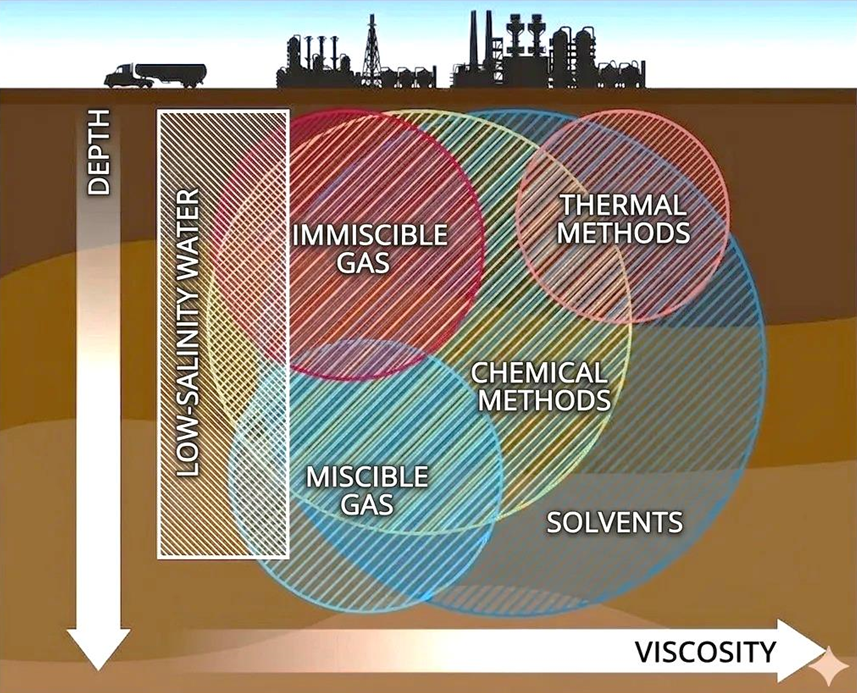
Limits of increasing oil recovery methods applicability (from open sources)
A number of researchers have studied the mechanism of interaction of CO2, methane and nitrogen with petroleum raw materials in reservoirs. The data obtained lead to the conclusion that CO2 behaves more positively in relation to other gas media in the conditions of extraction of residual petroleum raw materials, since it easily dissolves in it and the aquatic environment at relatively low pressure and temperature, which determines the increased profitability of extraction of residual petroleum raw materials by CO2 [3, 4].
The dynamic viscosity of CO2 is twice or three times higher than that of other gas media under consideration, which is important, since the ratio of viscosity of gas and reservoir liquid media determines the duration of displacement of crude oil by the injected agent until it passes into the wells. At the same time, the degree of CO2 compression also differs significantly from it for methane and nitrogen, especially at elevated pressure. The capacity of compressor stations used to compress gas media during transportation and injection into the reservoir structure is also determined by the degree of compression [3, 5, 6].
The main obstacle to the implementation of CO2 injection projects is its premature passage into the well. In order to minimize the mobility of CO2 and increase the efficiency of its contact with the displacing fluids of reservoir structures, it is recommended to introduce various chemical compounds into them. For example, surfactants with nanoparticles (NPS) form a stable foam structure with increased viscosity, which leads to an increase in the efficiency of washing oil raw materials by CO2. The use of a foam structure as an injected medium determines a more efficient displacement of petroleum raw materials in relation to flooding or injection of compressed CO2 [6, 7].
The high chemical stability of LPS even in harsh conditions of the existence of a reservoir structure and their significant selectivity of adsorption at the interface of liquid media is attractive for their use for the formation of emulsions and foam structures [3, 5], since the surface treatment of LPS can focus on specific molecules, which causes the formation of a foam system CO2/aqueous medium without the formation of emulsions of the oil raw materials/water environment. In this variant, nanofluidic media and nanofluidic media affect the interfacial tension (MFN), rheological parameters and the degree of surface wettability. Polymer solutions and surfactants can be modified by adding nanoparticles to change the wettability of the rock, reduce interfacial tension, and improve rheological properties. Thanks to these advantages, nanotechnology can revolutionize the ways of extracting petroleum raw materials [8].
In order to co-inject CO2 with NPS to form nanostructures stabilized by NPS, a threshold shear intensity is required [6, 9], the high value of which in permeable reservoir structures is present in the main flow channels, which are located mainly in the zones with the highest penetrating power. These parameters increase the likelihood of the formation of “self-conducting” fluids that selectively reduce the mobility of CO2, forming a foam structure only where CO2 is displaced at high speed, in particular, in fractured and/or areas of gravity with a relatively low concentration of residual petroleum. This foam structure has the ability to mix with it, which leads to an increase in the degree of extraction of petroleum raw materials associated with CO2 foam flows [8, 10].
Currently, LPS are widely used in many fields of research and in industry. They make it possible to improve the characteristics of underground fluids injected into boreholes and the behavior of reservoir fluids. Nanoparticles are able to penetrate porous underground environments, which allows them to travel long distances through pore spaces and channels in reservoir formations. [6, 9–11]. Their effects are facilitated by the interaction between injected and pore fluids, which allows them to influence specific zones and fluid flow characteristics deep in oil reservoirs.
In particular, the addition of NPS to a foam with a surfactant tends to improve the stability of the foam, which is due to their beneficial properties, such as the absence of exposure to certain characteristic conditions commonly found in oil formations, such as high temperatures and the presence of a number of hydrocarbons and/or salts. In addition, due to their small size, the LF flow through the porous medium is not significantly hindered by the reservoir matrix itself, which leads to minimal changes in reservoir permeability, while foam absorption by reservoir rocks is negligible. In addition, the materials from which the necessary NPS are obtained, for example, coal ash, can be obtained at minimal cost. Due to their grafting properties, the wettability of the nanoparticles can be changed relatively easily to obtain a foam resistant to groundwater. The degree and duration of foam stability depend on several factors, including the interaction between the size of the LF and the foam, the wettability of the LF surface, the concentration of LF and their surface charge, as well as the charge of the surfactant and the salinity of water, the saturation and temperature of reservoir oil, the properties of crude oil, the flow rate of liquid in the reservoir, as well as the absorption of foam by the formation matrix [6, 9–11].
Let us consider separately the influence of the main factors of the use of LPS for the purpose of efficiency of the heavy oil production process.
The effect of particle size on the characteristics of CO2 foam
Nanoparticles with a size of 20 nm most effectively increase the stability of the foam. Nanoparticles with a size of 20 nm create more uniform layers inside the foam, preventing it from enlarging and sticking together. The addition of various NPS (SiO2 A300 (hydrophilic), SiO2 R816 (hydrophobic), ZnO, TiO2) to the surfactant showed that foam stability is best improved when using SiO2 A300 due to the higher ratio of surface area to particle size. In addition, surfactants can attach to the surface of nanoparticles and increase their catalytic activity due to a larger surface area and a smaller particle size. As a result of the attachment of surfactant molecules to the surface of the NPS, steric lamella layers are formed that prevent compression and expansion. This feature helps the foam to maintain stability during storage and transportation [12].
The effect of the wettability of the woofer surface on the characteristics of CO2 foam
The surface wettability of NPS is determined by the ratio of the forces of adhesion of the molecules of the liquid medium and the molecules (or atoms) of the wetted substance/(adhesion) and the forces of mutual adhesion of the molecules of the liquid medium (cohesion). The effect of the wettability of the LF surface on the stability of the foam was evaluated using Aerosil SiO2 as a hydrophobic component. It was found that the stability of the foam increases, and the wetting edge angle increases by 26-56°. The addition of colloidal SiO2 AEROSIL816 and SiO2 AEROSIL300 to the surfactant sodium dodecyl sulfate showed that the wettability of the rock surface largely determines and controls the location, distribution, and movement of fluids in a particular formation [10, 13].
Effect of the concentration of hydrophilic NPS on the characteristics of CO2 foam
It is now well known that the presence of hydrophilic NPS increases the stability of the foam. The rheological properties of supercritical CO2 foam at various temperatures, foam qualities, and pressures are informative in this regard. The use of synergy between nanoparticles and polyoxyethylene lauryl ether (C12E23) to stabilize CO2 foam was evaluated using static stability tests, visualization of pores using microscopic models, and sandbag filling tests. NP-C12E23 is highly resistant to salinity and temperature. It perfectly controls the profile and blocks water, and during the experiments, the oil recovery coefficient increased by 20.1% after water injection. Most studies today are limited to one type of NPS or surfactant. Static and dynamic tests to assess the relative effectiveness of various types of NPS and surfactants in stabilizing CO2 foam under subcritical and supercritical conditions have not yet been carried out sufficiently [10, 14].
Influence of temperature on the characteristics of CO2 foam with LF
The effect of temperature on the stability of low-gain CO2 foam is complex and is associated with a number of competing processes. With increasing temperature, solvent evaporation
The number of foaming agents tends to increase, and as a result, depending on the concentration of the foaming agent and its structure, the stability of the foam may increase or decrease. The presence of SiO2 and/or Al2O3 NPS in the foam slows down the rate of liquid release, thereby slowing down the process of bubble fusion. This ultimately increases the half-life and stability of the foam at any temperature. It was found that Al2O3 NPS, regardless of the pH value of the system, have a more stabilizing effect than SiO2 NPS at all tested temperatures. As a result, it is noted that the stability of the foam in the presence of NPS decreases with increasing temperature [10, 15].
Conclusion
The analysis shows that the use of carbon dioxide (CO2) to enhance oil recovery is a promising area, especially in the extraction of hard-to-recover and residual petroleum raw materials. CO2 compares favorably with other gas agents (methane, nitrogen) with its high solubility, favorable dynamic viscosity and compression ratio, which ensures more cost-effective oil displacement. However, the key obstacle – the premature breakthrough of CO2 to the producing wells – significantly reduces the efficiency of the process. The most effective technical solution to this problem is the joint injection of CO2 with nanoparticles and surfactants, resulting in the formation of a stable highly viscous foam. This foam structure selectively reduces the mobility of CO2 in highly permeable channels and fractured zones, increasing reservoir coverage and oil recovery rate.
1. Zhumaev K. K., Turakulova M. K., Burhonov I. U. Metody razrabotki vysokovyazkoj nefti [Methods of high viscosity oil development]. Teoriya i praktika sovremennoj nauki, 2019, no. 3 (45), pp. 126-129.
2. Petrova L. V. i dr. Sovremennye problemy i perspektivy rosta dobychi tyazhelyh neftej v Rossii [Current problems and prospects of heavy oil production growth in Russia]. The Scientific Heritage, 2017, no. 13-2 (13), pp. 28-30.
3. Kalinin V. F. Geologo-fizicheskie kriterii vybora optimal'noj tehnologii povysheniya produktivnosti skvazhin metodom obrabotki prizabojnoj zony poverhnostno-aktivnymi veshchestvami [Geological and physical criteria for choosing the optimal technology for increasing well productivity by treating the bottomhole zone with surfactants]. Nedra Povolzh'ya i Prikaspiya, 2024, no. 115, pp. 4-36.
4. Gusejnov G. G. Issledovanie kriticheskih tehnologij dlya intensifikacii dobychi trudnoizvlekaemyh zapasov nefti [Research of critical technologies for the intensification of production of hard-to-recover oil reserves]. Nauchnye issledovaniya: itogi i perspektivy, 2021, vol. 2, no. 1, pp. 14-27.
5. Kalinin S. A., Morozyuk O. A. Razrabotka mestorozhdenij vysokovyazkoj nefti v karbonatnyh kollektorah s is-pol'zovaniem dioksida ugleroda. Analiz mirovogo opyta [Development of high-viscosity oil deposits in carbonate reservoirs using carbon dioxide. Analysis of world experience]. Vestnik PNIPU. Geologiya. Neftegazovoe i gornoe delo, 2019, vol. 19, no. 4, pp. 373-387.
6. Kalinin S. A., Morozyuk O. A. Laboratornye issledovaniya karbonatnyh kollektorov mestorozhdenij vysokovyazkoj nefti s ispol'zovaniem dioksida ugleroda [Laboratory studies of carbonate reservoirs of high-viscosity oil deposits using carbon dioxide]. Nedropol'zovanie, 2020, vol. 20, no. 4, pp. 369-385.
7. Stromov K. A., Garipov A. F. Osobennosti, vozmozhnye oslozhneniya i nedostatki ispol'zovaniya dioksida ugleroda dlya povysheniya nefteotdachi Features, possible complications and disadvantages of using carbon dioxide to enhance oil recovery [Features, possible complications and disadvantages of using carbon dioxide to enhance oil recovery]. Innovacionnye nauchnye issledovaniya, 2021, no. 5-2, pp. 56-61.
8. Karamyshev V. G., Ehpshtejn A. R., Pchelincev Yu. V. Primenenie metodov nanotehnologij dlya intensifikacii dobychi nefti [Application of nanotechnology methods to intensify oil production]. Neftepromyslovoe delo, 2008, no. 1, pp. 25-27.
9. Garaev T. G. Perspektivy primeneniya nanotehnologij pri dobyche nefti [Prospects for the use of nanotechnology in oil production]. Problemy geologii i osvoeniya nedr: trudy XVIII Mezhdunarodnogo simpoziuma imeni akademika M. A. Usova studentov i molodyh uchenyh, Tomsk, 7–11 aprelya 2014 g. Tomsk, Izd-vo TPU, 2014. Vol. 2. Pp. 70-72.
10. Al-Shargabi M., et al. Carbon dioxide applications for enhanced oil recovery assisted by nanoparticles: Recent developments. ACS omega, 2022, vol. 7, no. 12, pp. 9984-9994.
11. Vorob'ev A. E. Osnovnye principy ehffektivnogo primeneniya promyshlennyh nanotehnologij pri dobyche akval'nyh gazogidratov [Basic principles of effective application of industrial nanotechnology in the extraction of aquatic gas hydrates]. Ehkspoziciya Neft' Gaz, 2015, no. 2 (41), pp. 28-31.
12. Ahmadi Y., Mansouri M., Jafarbeigi E. Improving simultaneous water alternative associate gas tests in the presence of newly synthesized γ-Al2O3/ZnO/urea nano-composites: an experimental core flooding tests. ACS omega, 2022, vol. 8, no. 1. pp. 1443-1452.
13. Raza M. A., Kooij E. S. Toward Superhydrophobic Surfaces: Controlling Wetting Characteristics. Surface and Inter-face Science. Vol. 7: Liquid and Biological Interfaces, 2020, pp. 391-440.
14. Alabdulmuhsin A. H., Alaithan M. S., Asif A. B. Enhancing Gas Production and Fluid Recovery in Water Sensitive HPHT Sandstone Formation by Using Pre-Pad CO2 Proppant Fracturing Stimulation. SPE Asia Pacific Oil and Gas Confer-ence and Exhibition. SPE, 2025. P. D031S027R003.
15. Awan M. M. A., Kirmani F. U. D. Achieving Low-Carbon Future through CO2 Storage: A Comprehensive Review of Global Projects and Policies. Petroleum Research, 2025, vol. 4, p. 004.