













с 01.01.2000 по 01.01.2006
Владивосток, Россия
Россия
Россия
УДК 656.6 Эксплуатация водного транспорта
Контейнерные перевозки являются неотъемлемой частью международной торговли. Благодаря стандартизации контейнеров и развитой логистической инфраструктуре они обеспечивают быструю, надежную и экономически эффективную доставку разнообразных грузов между странами и континентами. Контейнеризация способствует оптимизации транспортных цепочек, снижению издержек и упрощению таможенных процедур, что делает ее ключевым элементом глобальной экономики. Грузовой план для конкретного коммерческого судна является основополагающим с точки зрения безопасности, т. к. его неверное заполнение оказывает наивысшую степень влияния на безопасную перевозку грузов. Поскольку доля контейнерных перевозок в общем грузообороте непрерывно увеличивается, то проблема неправильного декларирования грузоотправителями фактического веса контейнеров становится все более актуальной. Неверное декларирование веса контейнеров может быть связано как с желанием грузоотправителя сэкономить на транспортировке груза, так и с ошибочной оценкой веса груза, либо с неучетом веса тары груза, материалов сепарации и т. п. Избыточно загруженные контейнеры или контейнеры с неправильно указанным весом создают серьезные проблемы с точки зрения обеспечения безопасности транспортного судна – могут привести к потере остойчивости судна, увеличивая риск обрушения штабелей, а также перегрузочного оборудования для обработки контейнеров, создавая опасность во время погрузки и разгрузки в портах и на складах. При обнаружении расхождений в весе контейнеры могут быть задержаны в портах или возвращены грузоотправителю. Рассматриваются основные причины и последствия неправильного декларирования веса контейнеров.
безопасность мореплавания, аварийность, контейнерные перевозки, вес контейнера, груз
Introduction
Currently, more than 6 300 container ships are continuously plying the oceans and other waterways, transporting cargo around the world. The range of cargo types transported in containers is noticeably expanding: it has become possible to ship the small batches liquid and bulk cargo in cargo transport units (CTU) as a result of the introduction of flexitanks and tank containers. Container transportation takes up an increasing share of the total cargo turnover due to the versatility in relation to the shipping cargo. An important advantage of the container method of cargo delivery is versatility in multimodal transportation. This advantage is more noticeable as longer the chain of delivery means from the supplier to the recipient.
Over the past 60 years the container capacity of ships has increased from 400 to approximately 19 500 containers (in conventional TEU), i.e. almost 50 times. Currently the largest container ships cost more than $150 million, and the cargo they carry can cost several billion US dollars at a time.
To make up a cargo plan is the biggest problem in container transportation. The distribution of cargo affects the vessel stability, which is directly related to the safety of navigation. Incorrect arrangement of containers on the vessel can lead to damage, loss of cargo, complete loss of stability and sinking of the vessel, and loss of the crew. Therefore, planning and proper loading of ships is an important tool to ensure the safe operation of the vessel [1].
A serious safety issue is the inaccuracy of the cargo containers weight measuring. Frequently, shippers estimate the particular consignment weight lower than the actual weight [2-4]. The reasons for this can be different. It happens that shippers calculate the size of the consignment based on the product data, but do not take into account the weight of transport packaging, separation materials, pallets and other auxiliary materials. In addition, the cost of transportation directly depends on the cargo weight, what encourages shippers to declare a weight lower than the actual weight.
The consequences of the incorrect information receiving of the container weight may be:
1. Incorrect cargo plan, what may have the following consequences:
– insufficient stability of the vessel, leading to large angles of list or capsizing;
– dangerous bending and torsion loads on the hull, which may lead to deformation or breakage of the vessel.
2. Difficulty in the handling equipment operation and the associated risks:
– removal and re-loading of containers (and the associated delays and costs) if excess weight is detected;
– risk of workers injury during loading and unloading operations.
3. Economic losses:
– disruption of the transport processing schedule and the entire supply chain of properly declared containers;
– losses in the accident event.
Container weighing inaccuracies can occur at any stage of the shipping process from initial loading to final delivery. Some of the causes of incorrect weight readings include:
1. Lack of uniform standards regarding the scales used: their accuracy and operating principle.
2. Human error: the operators who handle the weighing process may make errors in recording or interpreting weight data due to carelessness, lack of training, or a misunderstanding of the correct procedure.
Below are details of the investigations into the CMA CGM George Washington (MAIB investigation), President Eisenhower (NTSB investigation), MSC Zoe (DHS investigation) and other wrecks.
Materials and methods of the investigation
Overloaded containers or containers with incorrectly declared weights have historically created problems for both the carrier and the handling equipment when such containers handling [5, 6].
According to the World Shipping Council [7], in 2024, an estimated 576 containers were lost at sea out of approximately 250 million transported. While this represents an increase from 221 containers lost at sea in 2023, it remains well below the 10-year average of 1 274. In 2022, 661 containers were lost at sea. This represents less than one thousandth of 1% (0.00048%) of the roughly 250 million packed and empty containers currently shipped each year, with cargo transported valued at more than $7 trillion. Reviewing the results the WSC estimates that there was on average a total of 1 566 containers lost at sea each year. The average losses for the last three years were 2 301 containers per year. Statistics on the number of damaged and lost containers for the period 2016-2024 are shown in the Figure.
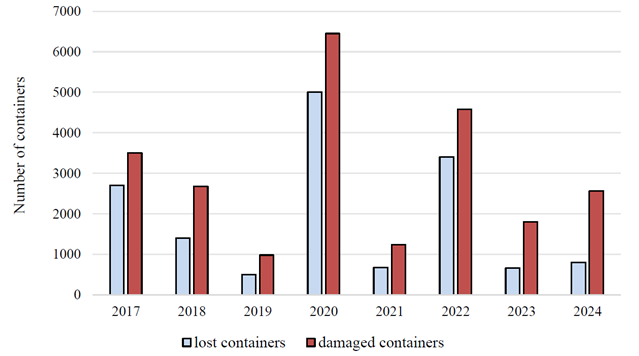
Statistics on the number of damaged and lost containers for the period 2016-2024
This increase of loss is due to factors such as increasing ship sizes, extreme weather conditions and incorrectly declared cargo weights (resulting in container stack collapses). On large container ships the stack height can reach 26 m. Heavy loads are created on the lower tiers of containers and fastening systems in heavy seas conditions [8-10].
Corrosion degradation and operational wear of fastenings lead to the fact that those containers whose weight does not exceed the established standards are often lost in intense rolling conditions. Exceeding the permissible containers weight initially lays the foundation for an emergency.
The container ship MOL Comfort accident is example of how misdeclared cargo can lead to an incorrect cargo plan, which can cause excessive hull deformation in rough seas. On 17 June 2013, the MOL Comfort, carrying 4 382 containers, broke into two and sank while 200 miles off the coast of Yemen. Some containers fell into the sea, some sank with the stern of the ship, and some were destroyed by a fire in the bow of the ship, which was still afloat. Evidence was lost along with the lost cargo, but the official investigation considered the possibility that misdeclared cargo contributed to the incident. The examined sister ships data showed both under- and overweight containers [6, 7, 11].
Incorrect reported weights can cause a stack to collapse even in calm port conditions. In February 2007, a stack of containers on the container ship Limari collapsed in the port of Damietta, Egypt, due to excessive weight. The captain’s incident report to the authorities noted that excessively heavy containers were loaded on the upper tiers and the maximum stack weight was significant exceeded in some rows. The excessive containers weight placed excessive stress on the lashings. In addition, excessively uneven weight distribution and/or exceeding the maximum weight in any stack will result in excessive stress on the stacking/securing elements and excessive stress on the containers. The actual weight of the containers was determined using devices on the gantry cranes when lifting and moving the collapsed containers. The actual weight of the containers exceeded the declared weight by 362% (row 08), 393% (row 06), 407% (row 04) and 209% (row 02) in row 52, where the collapse occurred [12].
Let us recall some incidents involving the loss of con tainers at sea, which received wide resonance in the press (Table).
Some of the accidents involving the loss of a large number of containers
|
Date |
Ship name |
Accident |
Number of lost containers |
|
06/02/2024 |
President Eisenhower |
Collapse of stacks |
23 |
|
24/05/2020 |
APL England |
Collapse of stacks |
50 |
|
01/06/2018 |
Yang Ming Marine Transport |
Collapse of stacks |
81 |
|
20/01/2018 |
CMA CGM G. Washington |
Collapse of stacks |
137 |
|
14/02/2014 |
Svendborg Maersk |
Collapse of stacks |
More than 500 |
|
17/06/2013 |
MOL Comfort |
Fracture and flooding |
4 293 |
|
11/06/2011 |
Deneb |
Capsizing a ship |
– |
|
18/01/2007 |
MSC Napoli |
Collapse of stacks |
103 |
|
February 2007 |
Limari |
Collapse of stacks |
– |
|
27/01/2007 |
P&O Nedlloyd Genoa |
Collapse of stacks |
27 |
Discussion
In 2014 the International Maritime Organization (IMO) adopted rules on container weight verification, which amended Chapter VI of the International Convention for the Safety of Life at Sea (SOLAS 1974) [11]. It noted that misdeclaration “represents the most significant risk” to container shipping, leading to major losses. The adopted rules focus on “overweight” containers, where the declared weight is less than the actual weight. Containers overloaded beyond their declared capacity are a problem particularly for 40-foot containers, which can be overloaded even when carrying moderately dense cargo. Under the current rules, containers exceeding their declared capacity cannot be loaded on board a ship (SOLAS 1974: Annex, Regulation VI 5 (5). The new obligation is to weigh the container or its contents and declare that weight.
The Verified Gross Mass (VGM) regulation, which came into force in 2016, was intended to significantly reduce the risk of incorrectly declared weights in container shipping, which can lead to stack collapses and dangerous stability issues. A recent incident involving a US-flagged container ship, where an incorrectly declared weight resulted in a stack collapse and the loss of 23 containers, highlighted the potential dangers that still exist when incorrect weights are entered into booking systems and containers are not re-weighed before loading.
Shipmasters have primary responsibility for the safety of the ship, including the cargo. They may also be responsible for the container weight. However, the IMO Sub-Committee on Dangerous Goods, Solid Cargo and Containers considers that it is not practical to assign shipmasters primary responsibility for container weight, because they do not have the technical capacity to check the weight. Furthermore, cargo shipments are planned and prepared for loading on board ships well in advance in order to minimise the time the ship spends at berth. It would be highly inefficient to perform check weighing during loading. Although checking the weight is the responsibility of the shipmaster, most modern container ships do not have lifting equipment, so shipmasters must rely on others to fulfil their general safety responsibilities.
Placing responsibility for the accuracy of container weight declaration on the shipper does not solve the problem in the case of deliberate misrepresentation. This type of misrepresentation can only be detected if an uninterested party carries out the control.
Ports are obvious points where container weights can be controlled, because all containers transported by sea pass through them and container handling is carried out using shore cranes. However, involving ports in the container weight control process creates an additional party in the distribution of responsibility between the shipper and the ship's master occurred [13]. It also expand the scope of IMO's interest in ports, since the shipping contract is concluded between the shipper and the shipping company, and not between the shipper (or ship) and the port.
It is obvious that misdeclaration occurs on land (before loading onto a vessel). The danger of the consequences of misdeclaration for shipping should mean that all parties must comply with the rules.
Conclusion
The problem of weights misdeclaration is serious, leading to loss of vessels and cargo. Everyone involved in the container shipping industry understands that declaring the correct weight of containers improves the safety of container ships, their crews, and shore personnel involved in handling and shipping containers occurred [14, 15]. The current IMO weight control regulations alone are not an absolute protection against this problem. A “chain of responsibility” approach, where all parties involved in the shipping process contribute, is proposed as a way forward.
Currently, most specialized container terminals have automatic weighbridges occurred [16]. If the container cargo weight is not permissible, the master will refuse the container, so it is recommended to carefully read the maximum weight indicated on the container before loading to avoid the need to reload. Recording incidents of false information about container loading and taking administrative action against persistent offenders would go a long way towards solving the problem.
1. Царик Р. С. Комплексный подход к безопасности морских контейнерных перевозок // Мир трансп. 2016. Т. 14. № 3 (64). С. 212–231.
2. Тонконог В. В., Филатова Е. В., Головань Т. В. Проблемные вопросы занижения веса груза в контейнерах, перемещаемых морским транспортом // Путеводитель предпринимателя. 2018. № 40. С. 268–288.
3. Маликова Т. Е., Филиппова А. И. Разработка системы слежения за импортными грузопотоками, оформляемыми по технологии предварительного информирования в морском пункте пропуска // Мор. интеллектуал. технологии. 2016. № 4-2 (34). С. 32–36.
4. Янченко А. А., Маликова Т. Е. Методика анализа технологического процесса обработки груза на контейнерном терминале // Эксплуатация мор. трансп. 2020. № 2 (95). С. 20–26. DOIhttps://doi.org/10.34046/aumsuomt95/3.
5. Официальный сайт Совета по безопасности на транспорте Японии (JTSB). URL: https://www.mlit.go.jp/jtsb/english.html (дата обращения: 24.04.2025).
6. Официальный сайт Отделения по расследованию морских происшествий (MAIB). URL: https://www.gov.uk/government/organisations/marineaccident-investigation-branch (дата обращения: 24.04.2025).
7. Официальный сайт Всемирного совета судоходства. URL: https://www.worldshipping.org/ (дата обращения: 24.04.2025).
8. Ганнесен В. В., Соловьева Е. Е. Аварийность морских судов и методология поиска причинно-следственных связей, приведших к аварии // Науч. тр. Дальрыбвтуза. 2022. Т. 61. № 3. С. 70–76.
9. Drewry Container Trade Statistics. URL: https://www.drewry.co.uk/ (дата обращения: 13.04.2025).
10. Соловьева Е. Е., Ганнесен В. В. Тенденции аварийности морских судов // Науч. тр. Дальрыбвтуза. 2022. Т. 62. № 4. С. 118–125.
11. Официальный сайт Международной морской организации. URL: https://https://www.imo.org/ (дата обращения: 04.05.2025).
12. Containers Lost at Sea, World Shipping Council. URL: https://static1.squarespace.com/static/5ff6c5336c885a268148bdcc/t/6667a1b5a8b88c3efac6665e/1718067641677/Containers_Lost_at_Sea_2024_FINAL.pdf (дата обращения: 13.04.2025).
13. Чернова А. И., Авдонькин С. В. Современное состояние и пути совершенствования организации обеспечения безопасности мореплавания контейнеровозов // Трансп. дело России. 2013. № 2. С. 38–40.
14. Петрова Е. Е., Ганнесен В. В. Анализ опыта автоматизации и роботизации операционных процессов контейнерного терминала // Науч. проблемы вод. трансп. 2024. № 78. С. 178–190. DOIhttps://doi.org/10.37890/jwt.vi78.439.
15. Маликова Т. Е., Янченко А. А. Применение технологии предварительного информирования таможенных органов при морских внеплановых грузоперевозках // Вестн. Гос. ун-та мор. и реч. флота им. адм. С. О. Макарова. 2016. № 3 (37). С. 33–45. DOIhttps://doi.org/10.21821/2309-5180-2016-7-3-33-45.
16. Азовцев А. И., Маликова Т. Е., Филиппова А. И., Янченко А. А. Разработка инфологической модели базы данных предварительного информирования таможенных органов для судоходной компании // Мор. интеллектуал. технологии. 2016. № 3-1 (33). С. 327–332.