












Россия
Россия
Астраханская область, Россия
Представлены результаты разработки рыборастительных крипсов, включающие оптимизацию рецептур, органолептическую оценку и комплексную оценку качества. При получении рыборастительных крипсов использовались фарш толстолобика, нутовая мука, тыквенное пюре, морковное пюре, томатная паста, льняное семя, кунжутное семя, соевая клетчатка. Разработана технология производства рыборастительных крипсов. Отработан тепловой режим запекания. Проведена оценка пищевой ценности в соответствии с современными методами исследования. Для проведения органолептической оценки рыборастительных крипсов была разработана пятибалльная шкала с оптимальными дескрипторами. На основе пищевой ценности рассчитывался процент удовлетворения физиологической потребности людей с высокой когнитивной нагрузкой и низкой физической активностью при использовании в питании рыборастительных крипсов. Оптимальная с точки зрения адекватного нутриентного состава и органолептических характеристик рецептура рыборастительных крипсов удовлетворяет физиологическим потребностям людей с высокими когнитивными нагрузками и низкой физической активностью по содержанию в продукте белка на 23,24 %, пищевых волокон – 30,27 %, жиров – 7,66 %, углеводов – 8,56 %. Употребление в сутки 100 г рыборастительных крипсов, приготовленных по рецептуре, включающей фарш толстолобика, нутовую муку, тыквенное пюре, морковное пюре, томатную пасту, льняное семя, кунжутное семя, соевую клетчатку, позволяют удовлетворить потребности организма в витамине В1 на 14,4 %, витамине В4 на 18,1 %, витамине В5 на 19,4 %, в калии на 19,2 %, фосфоре на 47,3 %, магнии на 25,4 %, кальции на 16,7 %, селене на 28,5 %, цинке на 18,2 %, железе на 24,7 %, что дает возможность говорить о функциональных свойствах разработанного рыборастительного продукта.
высокая когнитивная нагрузка, низкая физическая активность, рыборастительные крипсы, пищевая ценность, нутовая мука, фарш толстолобика
Introduction
In the modern world, where many professions are associated with work with a high cognitive load with low physical activity in offices, home remote work or study, the organization of rational nutrition is becoming particularly relevant. A sedentary lifestyle and inadequate nutrition cause fatigue, decreased concentration and cognitive activity, which can lead to a deterioration in the overall health of employees and students, as well as a decrease in the effectiveness of work activities. Eating habits with constant cognitive stress are of great importance in maintaining mental activity, concentration and memory. Unlike conventional nutrition, which focuses on maintaining overall physical energy and health, the diet for people facing high cognitive loads requires the presence of certain nutrients necessary for the brain to function in a high cognitive load mode.
The brain consumes a significant amount of energy, especially when there is a high cognitive load. Carbohydrates in this case are an easily accessible source of energy for the body, ensuring a stable blood glucose level. Complex carbohydrates such as whole grains, vegetables, and fruits are preferable to simple sugars, such as refined sugar, as they provide a longer release of energy and stabilize blood sugar levels, which can affect concentration and drowsiness. Vitamins and minerals, including B vitamins and magnesium, are essential for improving cognitive functions such as memory and attention. B vitamins are important for the synthesis of neurotransmitters such as serotonin or dopamine, and magnesium helps reduce stress levels, which often accompany increased stress on the brain. Increased cognitive load increases the body's need for antioxidants, as the active work of the brain is accompanied by the formation of free radicals. Antioxidants such as vitamins C and E, as well as polyphenols, help protect the brain from damage and keep it functioning. Data on physiological needs for people with a sedentary lifestyle and high cognitive loads (FAC – 1.4) per day [1] are shown in Table 1.
Table 1
Standards of energy and nutritional requirements
|
Indicator |
Men, age |
Women, age |
|||||
|
18-29 |
30-44 |
45-64 |
18-29 |
30-44 |
45-64 |
||
|
Energy, kcal |
2 400 |
2 300 |
2 150 |
1 900 |
1 800 |
1 700 |
|
|
Protein, g |
84 |
81 |
75 |
67 |
63 |
60 |
|
|
Fats, g |
80 |
77 |
72 |
63 |
60 |
57 |
|
|
Carbohydrates, g |
336 |
322 |
301 |
266 |
252 |
238 |
|
|
Dietary fiber, g |
20-25 |
||||||
|
Thiamine (B1), mg |
1.5 |
||||||
|
Riboflavin (B2), mg |
1.8 |
||||||
|
Choline (B4), mg |
400 |
||||||
|
Pantothenic acid (B5), mg |
5 |
||||||
|
Pyridoxine (B6), mg |
2 |
||||||
|
Potassium (K), mg |
3 500 |
||||||
|
Phosphorus (P), mg |
700 |
||||||
|
Magnesium (Mg), mg |
420 |
||||||
|
Calcium (Ca), mg |
1 000 |
||||||
|
Selenium (Se), mcg |
70 |
55 |
|||||
|
Zinc (Zn), mg |
12 |
||||||
|
Iron (Fe), mg |
10 |
18 |
|||||
Satisfaction of the body's nutritional needs for this group of people (with low physical activity and high cognitive loads) can be achieved through the development of innovative products that simultaneously provide optimal levels of nutrients and are easily absorbed by the body without affecting weight [2]. When developing such products with specified properties, it is necessary to adhere to certain methodological approaches described in the sources [3, 4]. One of the promising solutions in this area is the development of snack products aimed at improving cognitive functions and maintaining a balanced diet with
a low level of physical activity. Fish-growing creeps containing proteins, healthy fatty acids, vitamins and trace elements can become an innovative product capable of meeting these needs. The study of the nutritional value of such crisps, their effect on cognitive functions and metabolism, as well as the technological aspects of their production is an important task aimed at creating a healthy alternative to traditional snacks [5, 6].
Scientists at Astrakhan State Technical University are conducting research on the combination of fish and vegetable raw materials. A feature of fish raw materials is its high biological value due to the optimal balance of essential nutrients, and a feature of plant raw materials is its complex and diverse chemical composition, including a wide range of biologically active substances necessary to maintain homeostasis and ensure the physiological functions of the body. A variety of fish-growing ingredients are used to create balanced and attractive food products [7, 8]. Aquaculture facilities such as silver carp [9] and tilapia [6, 7] are used as fish raw materials. Creeps are a food product that is an alternative to traditional chips and has a fundamentally different production technology. Unlike chips, which are made primarily from thinly sliced raw materials (for example, potatoes or carrots), chips are made on the basis of multicomponent mixtures, including modified forms of raw materials such as mashed potatoes, starch-containing ingredients, as well as additional components (emulsifiers, stabilizers, flavors, etc.), providing specified textural and organoleptic properties. This technology allows for a higher degree of control over the structure and composition of the final product.
Creeps are made by pressing or extrusion, which gives them a more uniform structure and allows you to set any shape of cutting. Creeps contain less fat due to a fundamentally different heat treatment technology, since creeps are baked, unlike chips that are fried in oil. Creeps can be developed by combining different food ingredients and thermal modes, creating them from a variety of raw materials.
The main goal of the experiment was to develop a technology for preparing fish-growing creeps based on an optimal combination of minced carp, chickpea flour, pumpkin puree, carrot puree, tomato paste, flaxseed, sesame seeds and soy fiber. The following tasks were solved in the framework of the study:
– assessment of the characteristics of raw materials: nutritional value and energy value of fish and vegetable raw materials;
– modeling and optimization of creeps formulations;
– assessment of the nutritional value of the developed creeps.
Ground carp is a highly nutritious raw material containing easily digestible proteins and fatty acids, which makes it a promising component of functional products.
Chickpea flour is a rich source of vegetable protein and fiber, which helps to improve the nutritional value of products based on it. Due to its high emulsifying and binding properties, chickpea flour stabilizes the texture and improves the organoleptic characteristics of finished products.
The chemical composition of the ingredients [10] included in the formulation of fish-growing creeps is shown in Table 2.
Table 2
Chemical composition of ingredients of fish-growing creeps
|
Indicators |
Content per 100 g of product |
|||||||
|
Minced carp |
Chickpea flour |
Pumpkin puree |
Carrot puree |
Tomato paste |
Flaxseed |
Sesame seed |
Soy fiber |
|
|
Proteins , g |
6.8 |
8.4 |
0.1 |
0.1 |
0.3 |
0.65 |
0.7 |
0.4 |
|
Fats, g |
0.3 |
1.8 |
– |
– |
– |
0.5 |
0.6 |
– |
|
Carbohydrates, g |
– |
19.4 |
0.3 |
0.5 |
1.3 |
0.05 |
0.45 |
1.3 |
|
Dietary fiber, g |
4.2 |
0.1 |
0.2 |
0.1 |
0.95 |
0.2 |
||
|
Ash, g |
0.7 |
1.5 |
0.1 |
0.2 |
0.1 |
0.1 |
||
|
Water, g |
24.5 |
5.9 |
6.4 |
6.2 |
4.9 |
0.25 |
0.3 |
0.1 |
|
Vitamins |
||||||||
|
Thiamine (B1), mg |
0.049 |
0.034 |
0.004 |
0.004 |
0.011 |
0.0575 |
0.0445 |
– |
|
Riboflavin (B2), mg |
0.019 |
0.089 |
0.005 |
0.012 |
0.0055 |
0.0125 |
||
|
Choline (B4), mg |
22.75 |
39.98 |
0.57 |
0.62 |
2.7 |
2.755 |
0.895 |
|
|
Pantothenic acid (B5), mg |
0.07 |
0.667 |
0.028 |
0.018 |
0.06 |
0.0345 |
0.024 |
|
|
Pyridoxine (B6), mg |
0.06 |
0.225 |
0.009 |
0.009 |
0.044 |
0.0165 |
0.005 |
|
|
Macronutrients |
||||||||
|
Potassium (K), mg |
92.75 |
406.56 |
14.28 |
14 |
61.25 |
28.455 |
17.395 |
– |
|
Phosphorus (P), mg |
73.5 |
186.5 |
1.8 |
3.9 |
4.8 |
22.45 |
25.2 |
|
|
Magnesium (Mg), mg |
8.75 |
52.92 |
0.98 |
2.66 |
3.5 |
13.27 |
18.9 |
|
|
Calcium (Ca), mg |
12.25 |
81.06 |
1.75 |
1.89 |
1.4 |
8.925 |
51.59 |
|
|
Trace elements |
||||||||
|
Selenium (Se), mcg |
4.41 |
11.97 |
0.21 |
0.007 |
0.371 |
0.889 |
1.204 |
– |
|
Zinc (Zn), mg |
0.245 |
1.2 |
0.01 |
0.028 |
0.077 |
0.15 |
0.355 |
|
|
Iron (Fe), mg |
0.28 |
1.092 |
0.028 |
0.049 |
0.161 |
0.2 |
0.56 |
|
According to the information presented in Table 2, it can be concluded that the plant components (chickpeas, flaxseed and sesame seeds) make it possible to create nutritionally balanced fish-growing creeps.
The introduction of chickpea flour, for example, helps enrich the product with choline, potassium, iron and selenium. The use of any herbal ingredients additionally increases the content of carbohydrates and dietary fiber, which is an important aspect for the diet during long-term expeditions. In addition, herbal ingredients improve the textural properties of creeps, giving them a more pronounced crispness.
Materials and methods of research
The main raw materials for the developed fish-growing creeps were:
– minced carp meat, as a source of healthy animal proteins and fats;
– chickpea flour, as a source of vegetable protein and fiber, enriching the product with amino acids and dietary fiber;
– pumpkin puree, a source of beta-carotene and potassium, helps to improve the antioxidant properties of the product;
– carrot puree, a rich source of vitamin A and dietary fiber, essential for vision and strengthens the digestive system;
– tomato paste, a concentrated source of lycopene and vitamin C, which have antioxidant effects;
– flaxseed, a source of Omega-3 fatty acids and lignans that support the health of the cardiovascular system;
– sesame seed, the main source of calcium and vitamin E, helps strengthen bone tissue;
– soy fiber, a source of dietary fiber and isoflavones that support digestion and hormonal balance.
Samples of fish-growing creeps were prepared under the same conditions and thermal conditions. The finished products were analyzed, nutritional values were studied in terms of meeting the physiological needs of people with high cognitive loads and low physical activity according to the main indicators according to MP 2.3.1.0253-21 “Norms of physiological needs for energy and nutrients for various population groups of the Russian Federation”. Based on organoleptic analysis and assessment of nutritional value, the optimal formulation was selected.
The basic information about the conducted studies is given in Table 3.
Table 3
Information about the conducted studies of raw materials and fish-growing creeps
|
Indicators |
The research method |
|
Fat |
ISS 7636-85, ISS R 54607.5-2015 |
|
Protein |
ISS 54607.7-2016 |
|
Ash |
ISS R 54607.10-2017 |
|
Moisture |
ISS 7636-85 |
|
Mineral substances |
Atomic absorption |
|
Vitamins |
ISS 32042-2012 |
|
Dietary fiber |
ISS 34844-2022 |
Sampling of minced fish was carried out according to ISS 7636-85, finished products according to ISS R 54607.1-2011. The study of organoleptic quality indicators was carried out in accordance with ISS 7631-2008.
The organoleptic analysis of fish-growing creeps was carried out on the basis of a previously developed five-point scale. The characteristic value of each indicator was described based on the preparation technology and the ingredient composition of the product. A five-point scale developed for the texture, color, aroma, taste and appearance of fish-growing creeps allows you to comprehensively evaluate the product and draw conclusions on the refinement and further study of the product. The nutritional value of fish-growing creeps was optimized by mathematical modeling using the simplex method, which allows the selection of prescription mixtures corresponding to the best indicators of the generalized criterion.
The results of the study
Formulation development and modeling were carried out taking into account the balance of the main nutrients. The developed formulations of fish-growing creeps are presented in Table 4.
Table 4
Recipes of fish-growing creeps
|
Ingredients |
Ingredient content, g per 100 g of product |
|||
|
Sample 1 |
Sample 2 |
Sample 3 |
Sample 4 |
|
|
Minced carp |
37.0 |
30.0 |
40.0 |
45.0 |
|
Chickpea flour |
40.0 |
47.0 |
37.0 |
32.0 |
|
Pumpkin puree |
6.0 |
8.0 |
||
|
Carrot puree |
8.0 |
6.0 |
||
|
Tomato paste |
4.0 |
|||
|
Flaxseed |
1.0 |
|||
|
Sesame seed |
2.0 |
|||
|
Soy fiber |
2.0 |
|||
|
Total |
100.0 |
|||
Ground carp is mixed with chickpea flour, pumpkin puree, carrot puree, tomato paste, flaxseed, sesame seeds, soy fiber and ground in a blender. The resulting mass is spread on a silicone mat, covered with cling film, rolled out to a dough thickness of 2 mm and the film is removed. Then they are placed on a baking sheet and baked in a steam convector for 30 minutes at a temperature of 140 °C.
A special feature of the developed formulation is that the finished product does not contain food salt, added sugars and transisomeric fatty acids.
According to the average norms of physiological needs for the body of people with high cognitive loads and low physical activity (FAC-1.4) for the age range of 18-29 years, a comparative analysis of ready-made fish-growing creeps by nutritional value was carried out, and the percentage of satisfaction of physiological needs for basic nutrients, vitamins, macro- and microelements was determined. The data is presented in Tables 5, 6.
Table 5
The content of vitamins and minerals in the samples of fish-growing creeps
|
Indicators |
The value of the indicator, per 100 g of product |
|||||||
|
Sample 1 |
% of normal physiological needs |
Sample 2 |
% of normal physiological needs |
Sample 3 |
% of normal physiological needs |
Sample 4 |
% of normal physiological needs |
|
|
Vitamins |
||||||||
|
Thiamine (B1), mg |
0.21 ± 0.01 |
13.6 |
0.25 ± 0.02 |
14.4 |
0.22 ± 0.03 |
12.8 |
0.24 ± 0.02 |
14.0 |
|
Riboflavin (B2), mg |
0.14 ± 0.02 |
8.2 |
0.15 ± 0.01 |
8.63 |
0.13 ± 0.01 |
7.7 |
0.12 ± 0.03 |
6.92 |
|
Choline (B4), mg |
70.27 ± 0.01 |
17.6 |
72.07 ± 0.02 |
18.1 |
68.92 ± 0.01 |
17.2 |
64.46 ± 0.01 |
16.1 |
|
Pantothenic acid (B5), mg |
0.91 ± 0.03 |
18.1 |
0.97 ± 0.01 |
19.4 |
0.83 ± 0.02 |
16.6 |
0.71 ± 0.01 |
14.2 |
|
Macronutrients |
||||||||
|
Potassium (K), mg |
634.69 ± 0.02 |
18.2 |
672.14 ± 0.01 |
19.2 |
601.16 ± 0.02 |
17.2 |
534.30 ± 0.01 |
15.26 |
|
Phosphorus (P), mg |
318.15 ± 0.01 |
45.5 |
331.06 ± 0.03 |
47.3 |
307.19 ± 0.03 |
43.9 |
281.34 ± 0.02 |
40.19 |
|
Magnesium (Mg), mg |
101.43 ± 0.03 |
24.2 |
106.76 ± 0.02 |
25.4 |
96.59 ± 0.01 |
22.9 |
87.37 ± 0.01 |
20.8 |
|
Calcium (Ca), mg |
158.86 ± 0.01 |
15.8 |
167.19 ± 0.02 |
16.7 |
151.29 ± 0.01 |
15.1 |
136.98 ± 0.02 |
13.69 |
|
Trace elements |
||||||||
|
Selenium (Se), mcg |
19.00 ± 0.01 |
27.2 |
19.93 ± 0.02 |
28.5 |
18.31 ± 0.01 |
26.2 |
16.51 ± 0.03 |
23.72 |
|
Zinc (Zn), Mg |
2.06 ± 0.03 |
17.2 |
2.17 ± 0.01 |
18.2 |
1.96 ± 0.01 |
16.3 |
1.76 ± 0.02 |
14.66 |
|
Iron (Fe), mg |
2.37 ± 0.02 |
23.7 |
2.46 ± 0.01 |
24.7 |
2.28 ± 0.02 |
22.8 |
2.12 ± 0.01 |
21.09 |
Table 6
Energy and nutritional value of fish-growing creeps samples
|
Indicators |
The value of the indicator, per 100 g of product |
|||||||
|
Sample 1 |
% of normal physiological needs |
Sample 2 |
% of normal physiological needs |
Sample 3 |
% of normal physiological needs |
Sample 4 |
% of normal physiological needs |
|
|
Energy value, kcal |
210.7 |
9.8 |
222.3 |
10.3 |
200.3 |
9.3 |
179.5 |
8.4 |
|
Proteins, g |
17.4 ± 0.1 |
23.1 |
17.5 ± 0.1 |
23.24 |
17.4 ± 0.2 |
23.11 |
16.8 ± 0.1 |
22.29 |
|
Fats, g |
5.3 ± 0.2 |
7.4 |
5.4 ± 0.2 |
7.66 |
5.1 ± 0.1 |
7.18 |
4.8 ± 0.2 |
6.74 |
|
Carbohydrates, g |
23.3 ± 0.2 |
7.7 |
25.6 ± 0.2 |
8.56 |
21.6 ± 0.1 |
7.02 |
17.1 ± 0.3 |
5.72 |
|
Dietary fiber, g |
7.5 ± 0.1 |
28.2 |
7.5 ± 0.1 |
30.27 |
6.5 ± 0.1 |
26.26 |
5.7 ± 0.1 |
22.9 |
Based on the data presented in Table 5, it can be concluded that the content of vitamins, macro- and microelements is higher in sample 2, compared with other samples of fish-growing creeps formulations. The second in terms of nutrient content is sample 1, the third is sample 3 and the last is sample 4. The difference in nutrient content in sample 2 compared to sample 1 is an average of 6.29%, the largest difference is 19.04% in vitamin B1, the smallest is 2.56% in vitamin B4. The high nutrient content in sample 2 compared to other samples is due to the fact that this formulation contains more chickpea flour, which is the main source of vitamins, macro- and micronutrients. The consumption of 100 g of fish-growing crisps prepared according to sample 2 satisfies the body's needs for vitamin B1 – 14.4%, vitamin B2 – 8.63%, vitamin B4 – 18.1%, vitamin B5 – 19.4%, potassium – 19.2%, phosphorus – 47.3%, magnesium – 25.4%, calcium – 16.7%, selenium – 28.5%, zinc – 18.2%, iron – 24.7%. The content of proteins, fats, carbohydrates, and dietary fibers in the developed fish-growing complexes and the percentage of satisfaction of the physiological needs of people with high cognitive load and low physical activity in these nutrients are presented in Table 6. The data presented in Table 6 show that the energy value of the samples varies from 179.5 to 222.3 kcal per 100 g of product, which is about 8.4-10.3% of the physiological requirement. Sample 2 has the highest energy value of 222.3 kcal, and sample 4 has the lowest energy value of 179.5 kcal. All samples contain a significant amount of protein, from 16.8 to 17.5 g, which is about 22-23% of the daily value. This makes fish-growing creeps a good source of protein, especially in a diet where additional amounts of protein are required. The fat content in the samples is at the level of 4.8-5.4 g, which covers about 6.7-7.7% of the physiological norm. Differences in the amount of fat between the samples are minimal, which indicates a similar composition in this indicator. The samples contain from 17.1 to 25.6 g of carbohydrates, which is 5.7-8.6% of the norm. The highest carbohydrate content is observed in sample 2, and the lowest in sample 4. The fiber content in the samples varies from 5.7 to 7.5 g, covering 22-30% of the daily value. Sample 2 has the highest fiber content compared to the rest of the samples, this is due to the higher content of chickpea flour, namely 47 g per 100 grams of product.
During the organoleptic analysis of the samples, a sensory assessment was performed on a developed five-point scale. The organoleptic assessment was carried out on the basis of such parameters as visual characteristics (appearance and color), textural properties of fish-growing creeps, aromatic profile and taste qualities. Each score within the assessed characteristics corresponds to a verbal description, which is a concise semantic formulation. A high score is awarded in strict compliance with the technological standards of production, while a low score indicates the presence of deviations from the established technological parameters of the samples. The developed five-point scale is presented in Table 7.
Table 7
The point scale of the quality of combined fish-growing creeps
|
Indicators |
Description of indicators, points |
||||
|
5 |
4 |
3 |
2 |
1 |
|
|
Appearance |
Smooth shape, smooth surface, uniform structure |
Smooth shape, uneven surface |
Irregular shape, acceptable |
Uneven shape |
A shape with ragged edges |
|
Smell |
Pleasant aroma |
Pleasant fishy aroma |
An unbalanced strong fish smell |
Light aroma of oxidized fish oil |
Strong aroma of oxidized fish oil |
|
Taste |
Pleasant balanced taste |
Balanced with a slight fishy taste |
Unbalanced, with a fishy taste |
Unpleasant taste |
Bittersweet |
|
Texture |
Crunchy, easy to chew |
Crunchy |
Dense, not crisp enough |
Dense |
Crumbly |
|
Colour |
Bright orange |
Pale yellow |
Light brown |
Brown |
Dark brown |
A diagram accumulating data on the organoleptic assessment (tasting) of samples conducted by researchers as part of the development of fish-growing creeps is shown in Fig. 1. The conducted tasting assessment showed that all samples have decent organoleptic characteristics. Sample No. 2 has the highest organoleptic characteristics. The main differences in taste and texture are caused by the different ratio of chickpea flour and minced carp. The data obtained show the promise of research in this area.
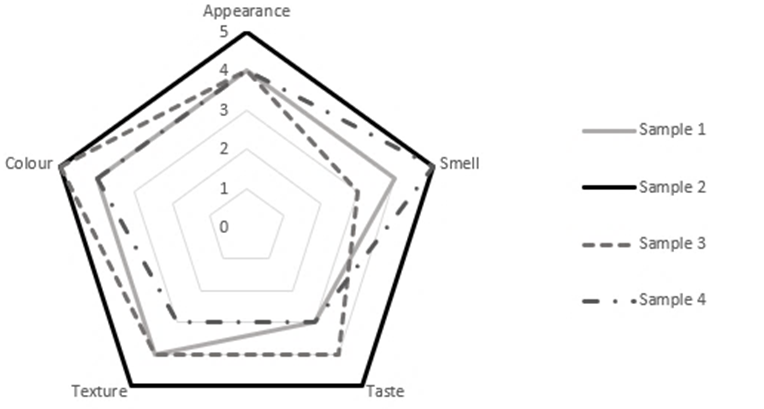
Fig. 1. The result of organoleptic evaluation (tasting) of fish-growing creeps samples
The appearance of the finished fish-growing creeps prepared according to Sample 2 is shown in Fig. 2.
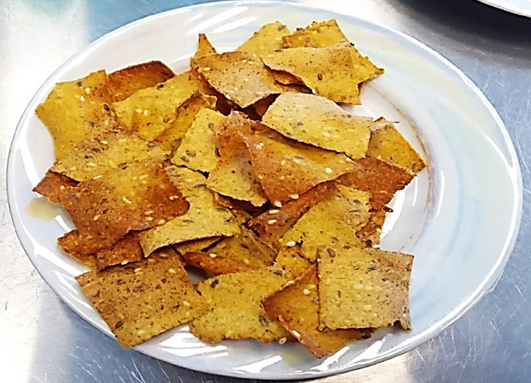
Fig. 2. Ready-made fish-growing creeps
Thus, sample No. 2 demonstrated the best results in both nutritional value and organoleptic properties, making it the most promising formulation. Its superior vitamin and mineral content, combined with excellent taste, is attributed to its higher proportion of chickpea flour.
Conclusion
As a result of the research, the technology of fish-growing creeps was developed, the thermal baking regime was worked out, the nutritional value was assessed, and an organoleptic assessment was carried out. The developed fish-growing creeps satisfy the physiological needs of people with high cognitive loads and low physical activity in protein – 23%, dietary fiber – 30%, vitamin B1 – 14.4%, vitamin B4 – 18.1%, vitamin B5 – 19.4%, potassium – 19.2%, phosphorus – 47.3%, magnesium – 25.4%, calcium – 16.7%, selenium – 28.5%, zinc – 18.2%, iron – 24.7%, which allows us to talk about the functional properties of the developed fish-growing product and recommend the developed creeps for nutrition of this population category.
1. МР 2.3.1.0253-21. Нормы физиологических потребностей в энергии и пищевых веществах для различных групп населения Российской Федерации. М., 2021. 72 с.
2. Касьянов Д. Г., Запорожский А. А. Технология рыборастительных продуктов для людей с пониженной физической активностью // Оптимизация технологических процессов и разработка новых, прорывных способов переработки агропищевого сырья и водных биологических ресурсов: сб. материалов Междунар. науч.-практ. конф., посвящ. 106-годовщине Куб. гос. технолог. ун-та (Краснодар, 29 марта 2024 г.). Краснодар: Изд-во КубГТУ, 2024. С. 156–159.
3. Викторова Е. П., Калманович С. А., Корнен Н. Н., Шахрай Т. А. Методологический подход к созданию обогащенных функциональных пищевых продуктов // Изв. вузов. Пищ. технология. 2018. № 5-6. С. 97–99.
4. Чугунова О. В., Заворохина Н. В. Перспективы создания пищевых продуктов с заданными свойствами, повышающих качество жизни населения // Изв. УрГЭУ. 2014. № 5 (55). С. 120–125.
5. Золотокопова С. В., Неваленная А. А., Сафронова Ю. Н., Байтельман А. К., Карапун М. Ю., Ковенькин Б. Е. Разработка комбинированных рыборастительных снеков // Вестн. Астрахан. гос. техн. ун-та. Сер.: Рыбное хозяйство. 2024. № 2. С. 101–108.
6. Неваленная А. А., Касьянов Г. И., Ковенькин Б. Е., Миронов А. И. Рыборастительные снеки из филе тилапии с морковью // Оптимизация технологических процессов и разработка новых, прорывных способов переработки агропищевого сырья и водных биологических ресурсов: сб. материалов Междунар. науч.-практ. конф., посвящ. 106-годовщине Куб. гос. технолог. ун-та (Краснодар, 29 марта 2024 г.). Краснодар: Изд-во КубГТУ, 2024. С. 179–183.
7. Золотокопова С. В., Касьянов Г. И., Золотокопов А. В., Лебедева Е. Ю. Функционально-технологические свойства рыборастительного фарша // Изв. вузов. Пищ. технология. 2020. № 4. С. 44–47.
8. Koroma I., Zolotokopova S. V., Kovenkin B. E., Pyanova E. S. Functional and technological properties of dry fish vegetable concentrates // Vestnik of Astrakhan State Technical University. Series: Fishing Industry. 2023. N. 3. P. 113–118.
9. Кулаченко В. П., Кулаченко И. В., Вошкин А. Г. Толстолобик – ценный объект прудовой аквакультуры // Рыбное хозяйство. 2016. № 5. С. 70–75.
10. Химический состав пищевых продуктов / под ред. проф., д-ра техн. наук И. М. Скурихина и проф., д-ра мед. наук М. Н. Волгарева. М.: Книга по требованию, 2023. Кн. 2. Справочные таблицы содержания аминокислот, жирных кислот, витаминов, макро- и микроэлементов, органических кислот и углеводов. 362 с.